News
Call for Nominations: Ice Core Working Group of the NSF Ice Drilling Program
The Ice Core Working Group (ICWG) of the NSF Ice Drilling Program (IDP) invites nominations, including self-nominations, from the U.S. scientific community to fill one open position on the ICWG. The ICWG aims to have diverse representation from a range of scientific expertise, institutional affiliation, and career stages. The ICWG welcomes nominations of all areas of ice core science, with a preference towards expertise in glaciology and/or physical properties of ice. Nominees must be U.S.-based scientists whose science relies on the analysis of ice or firn cores. The ICWG is one of two working groups of the IDP Science Advisory Board (SAB). The primary purpose of the ICWG is to provide advice and input on scientific issues pertaining to ice cores to the SAB and to the IDP. ICWG members typically serve for five years, participate in the annual ICWG meeting (which is usually online, with an in-person meeting in FY 2026), and collaborate remotely throughout the year as needed.
Please send nominations and expressions of interest to icedrill@dartmouth.edu at your earliest convenience before October 16, 2026.
Summer 2026 Ice Bits Newsletter Now Available
The Summer 2026 update of NSF Ice Drilling Program (IDP) activities is now available at:
https://icedrill.org/icebits/2026-summer
Topics:
- 2026 Spring/Summer Fieldwork Update
- Call for Nominations: Science Advisory Board of the NSF Ice Drilling Program
- 2026-2036 Long Range Science and Long Range Drilling Technology Plans Updated
- Requesting Field Support
- Acknowledgment of IDP in Publications
To view the newsletter, please go to:
https://icedrill.org/icebits/2026-summer
Call for Nominations: Science Advisory Board of the NSF Ice Drilling Program
The Science Advisory Board (SAB) for the NSF Ice Drilling Program (IDP) invites nominations, including self-nominations, from the U.S. scientific community to fill three open positions on the SAB. The SAB is seeking U.S.-based scientists with expertise in microbiology, ice-borehole/geophysical measurements, subglacial rock and sediment science, or related fields involving ice or subglacial materials and environments.
The primary purpose of the SAB is to provide advice and input on scientific issues pertaining to the NSF Ice Drilling Program, including annual updates to the IDP Long Range Science Plan. SAB members typically serve four-year terms, attend two annual SAB meetings per year – usually held virtually – and collaborate remotely as needed.
Please send nominations or self-nominations, including the nominee’s statement of interest and resume to the current SAB Chair, Sarah Shackleton (sarah.shackleton@whoi.edu), at your earliest convenience and no later than September 30, 2026.
2026-2036 Long Range Science and Long Range Drilling Technology Plans Updated
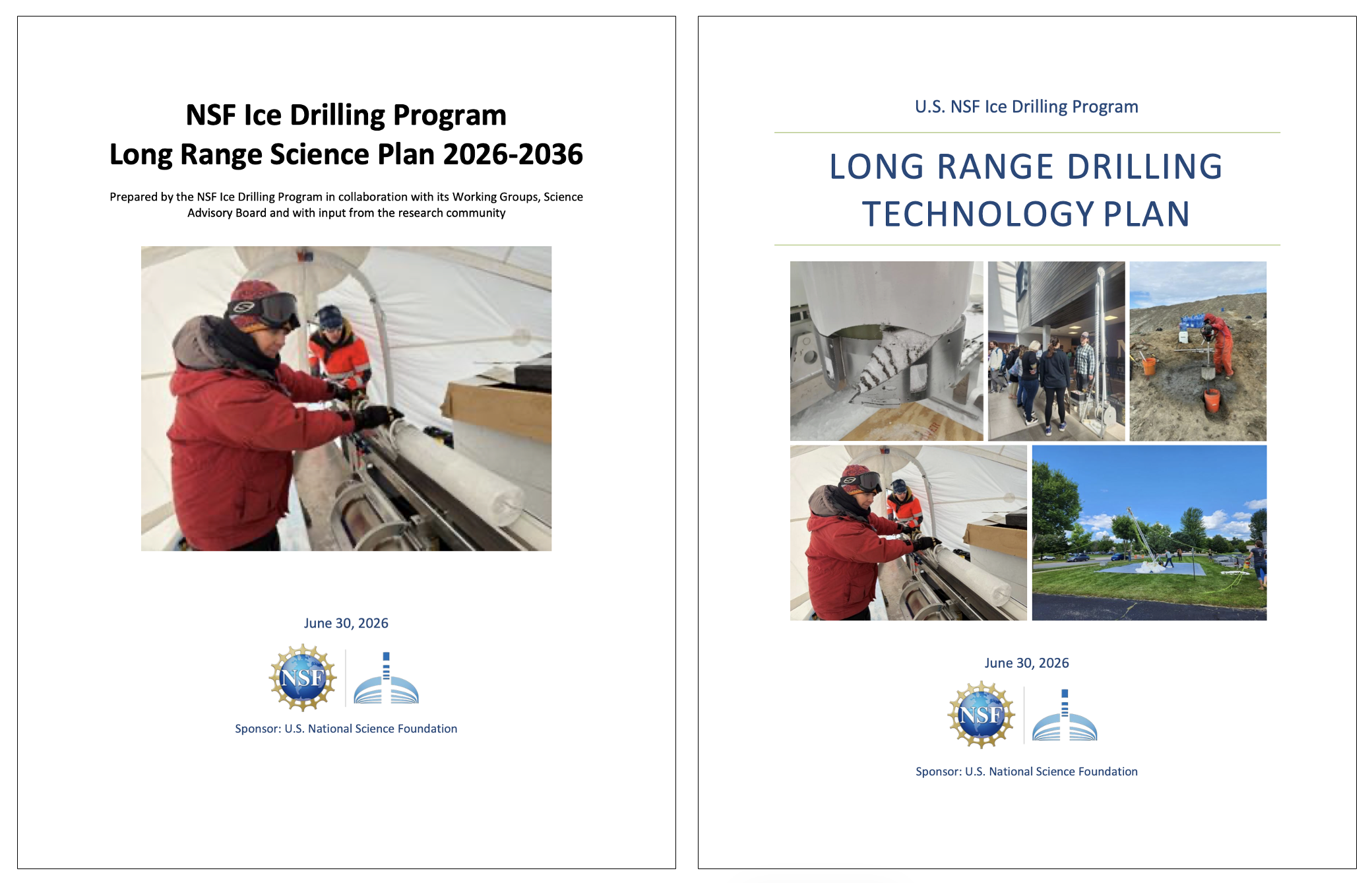
The NSF Ice Drilling Program (IDP), in collaboration with its Science Advisory Board and with input from the research community, updated the Long Range Science Plan. This plan aims to articulate goals and make recommendations for the direction of U.S. ice coring and drilling science across a wide variety of areas of scientific inquiry and to provide recommendations for the development of drilling technology, infrastructure, and logistical support necessary to enable the science. A companion document, the Long Range Drilling Technology Plan, provides details about drills available through IDP. Both plans are revisited and revised as appropriate each spring.
- The Long Range Science Plan is available at https://icedrill.org/long-range-science-plan.
- The Long Range Drilling Technology Plan is available at https://icedrill.org/long-range-drilling-technology-plan.
If you envision the need for ice drilling for your project in the coming decade, please make sure that the high-level articulation of your science is captured in the Long Range Science Plan. If it isn’t, send several sentences to IceDrill@Dartmouth.edu describing the science driver and the envisioned field date and location for your project so that your plans are voiced in this planning document.
Image
Spring 2026 Ice Bits Newsletter Now Available
The Spring 2026 update of NSF Ice Drilling Program (IDP) activities is now available at:
https://icedrill.org/icebits/2026-spring
Topics:
- 2026 Spring/Summer Fieldwork
- Joint ICWG-ESAWG Community Meeting
- New Sidewinder Instructional Videos
- Science Advisory Board 2026 Meeting
- Englacial and Subglacial Access Working Group 2026 Meeting
- Ice Core Working Group 2026 Meeting
- Requesting Field Support
- Acknowledgment of IDP in Publications
To view the newsletter, please go to:
https://icedrill.org/icebits/2026-spring
June 6 Deadline - Request for Community Input - DRAFT 2026 Long Range Science Plan
Each year in the spring, the U.S. National Science Foundation Ice Drilling Program (IDP) works with its Science Advisory Board and the research community to update the Long Range Science Plan. This Plan identifies the science in the coming decade that will require the use of ice drilling technology and expertise for the community. This also drives the formation of other plans, for example, the Long Range Drilling Technology Plan. The plans provide the basis for multi‐annual planning for the actions and drill development projects of IDP and others, and the plans give the funding agencies advance notice of upcoming community science needs.
If you need an ice core or a hole drilled in a glacier or ice sheet in the coming decade or a rock core from under shallow glacial ice, please make sure that the high‐level articulation of your science is captured in the current draft update of the Long Range Science Plan!
Please read through the draft Long Range Science Plan and send corrections, updates, or additions (SEE INSTRUCTIONS BELOW) to Icedrill@Dartmouth.edu at your earliest convenience and before June 6, 2026.
To download the working draft, visit:
https://icedrill.org/long-range-science-plan
Instructions for sending corrections/updates/comments:
- Write your corrections/updates/comments in your own Word document that you create; please don't send an annotated version of the draft plan
- For each correction/update/comment, please reference the appropriate line number in the draft Long Range Science Plan where the correction/update is needed
- Email the Word document to Icedrill@Dartmouth.edu before June 6, 2026
Submission deadline: At your earliest convenience and before June 6, 2026
REMINDER - Request for Community Input - DRAFT 2026 Long Range Science Plan
Each year in the spring, the U.S. National Science Foundation Ice Drilling Program (IDP) works with its Science Advisory Board and the research community to update the Long Range Science Plan. This Plan identifies the science in the coming decade that will require the use of ice drilling technology and expertise for the community. This also drives the formation of other plans, for example, the Long Range Drilling Technology Plan. The plans provide the basis for multi‐annual planning for the actions and drill development projects of IDP and others, and the plans give the funding agencies advance notice of upcoming community science needs.
If you need an ice core or a hole drilled in a glacier or ice sheet in the coming decade or a rock core from under shallow glacial ice, please make sure that the high‐level articulation of your science is captured in the current draft update of the Long Range Science Plan!
Please read through the draft Long Range Science Plan and send corrections, updates, or additions (SEE INSTRUCTIONS BELOW) to Icedrill@Dartmouth.edu at your earliest convenience and before June 6, 2026.
To download the working draft, visit:
https://icedrill.org/long-range-science-plan
Instructions for sending corrections/updates/comments:
- Write your corrections/updates/comments in your own Word document that you create; please don't send an annotated version of the draft plan
- For each correction/update/comment, please reference the appropriate line number in the draft Long Range Science Plan where the correction/update is needed
- Email the Word document to Icedrill@Dartmouth.edu before June 6, 2026
Submission deadline: At your earliest convenience and before June 6, 2026
Request for Community Input - DRAFT 2026 Long Range Science Plan
Each year in the spring, the U.S. National Science Foundation Ice Drilling Program (IDP) works with its Science Advisory Board and the research community to update the Long Range Science Plan. This Plan identifies the science in the coming decade that will require the use of ice drilling technology and expertise for the community. This also drives the formation of other plans, for example, the Long Range Drilling Technology Plan. The plans provide the basis for multi‐annual planning for the actions and drill development projects of IDP and others, and the plans give the funding agencies advance notice of upcoming community science needs.
If you need an ice core or a hole drilled in a glacier or ice sheet in the coming decade or a rock core from under shallow glacial ice, please make sure that the high‐level articulation of your science is captured in the current draft update of the Long Range Science Plan!
Please read through the draft Long Range Science Plan and send corrections, updates, or additions (SEE INSTRUCTIONS BELOW) to Icedrill@Dartmouth.edu at your earliest convenience and before June 6, 2026.
To download the working draft, visit:
https://icedrill.org/long-range-science-plan
Instructions for sending corrections/updates/comments:
- Write your corrections/updates/comments in your own Word document that you create; please don't send an annotated version of the draft plan
- For each correction/update/comment, please reference the appropriate line number in the draft Long Range Science Plan where the correction/update is needed
- Email the Word document to Icedrill@Dartmouth.edu before June 6, 2026
Submission deadline: At your earliest convenience and before June 6, 2026
Winter 2025-2026 Ice Bits Newsletter Now Available
The Winter 2025-2026 update of NSF Ice Drilling Program (IDP) activities is now available at:
https://icedrill.org/icebits/2025-2026-winter
Topics:
- IDP Completes Support of 2025-2026 Antarctic Field Season
- IDP Leads Town Hall at the AGU 2025 Fall Meeting
- Recent IDP Outreach Highlights
- IDP Ice Core Community Workshop December 2026
- IPICS 2026 Open Science Conference in North America
- Requesting Field Support
- Acknowledgment of IDP in Publications
To view the newsletter, please go to:
https://icedrill.org/icebits/2025-2026-winter
Next week! IPY5 Workshop Proceedings Webinar
IPY5 Workshop Proceedings Webinar
Exploring Key Research Topics for the Fifth International Polar Year
Tuesday, March 10, 2026 1:00 PM – 2:00 PM EDT
https://events.nationalacademies.org/46450
Planning is underway for the Fifth International Polar Year (IPY5), which will take place in 2032-2033 to advance scientific understanding of the polar regions through international coordination and national investments in research.
An interdisciplinary workshop held on May 20-21, 2025, was convened to consider research and monitoring priorities for IPY5. A proceedings publication summarizing the workshop discussions will be released prior to this webinar. Topics include potential priority science areas such as sea level rise, permafrost, and the carbon cycle; enabling capabilities such as shared data systems; and strategies for strengthening partnerships and building durable programs that serve decision-makers.
This webinar will summarize key themes from the workshop and highlight discussion topics from the new proceedings. Participants will have the opportunity to ask questions following the presentation. A recording will be posted after the event.
Title: Workshop Proceedings Release Webinar: Exploring Key Research Topics for the Fifth International Polar Year
Convener: National Academies
Date: Tuesday, March 10, 2026
Time: 1:00 pm - 2:00 pm Eastern Time
Where: Virtual webinar
Registration: https://events.nationalacademies.org/46450