
The Blue Ice Drill (BID) is an agile drill capable of retrieving cores of approximately 241 mm (9-1/2 inches) in diameter. The BID system was originally designed with a depth capability of 30 m, but was modified in 2014 in an attempt to collect cores to 200 m depth. A new cable winch and tower were implemented as well as new down-hole components. Depth capability is influenced by site/ice and firn depth characteristics.
Use of a MAST Tent has allowed operations to continue in poor weather conditions. Maintenance is conducted each year. In spring 2024, wiring in the winch control box was modified, greatly improving efficiency of operations in the field. Cutter holders and carbide inserts were designed, fabricated, and have been used with good success in the Allan Hills region of Antarctica. In FY 2024, IDP conducted a Blue Ice Core Quality Feasibility Study to evaluate long-term drilling approaches for retrieving high-quality ice cores in blue ice areas. IDP completed a report in January 2025 summarizing the findings of the study and worked with the community to formulate science requirements for a next-generation BOLD Drill (Borehole of Large Diameter).
Prior to the 2024-2025 Antarctic season, IDP added a load cell to the crown sheave to provide operators with more feedback and a penetration drive to allow for finer control. A steel core barrel was fabricated and tested but does not appear to improve core quality.
Current Status
The BID deploys regularly. Several components are aging beyond their useful life and are being replaced.
In FY 2026, IDP is working to complete the Conceptual Design of a new large-diameter ice coring drill.
Technical Issues
Collecting good core quality at greater depths has proven to be an issue. The drill can easily drill through at least 80 m of firn, and deeper through another 70 m of solid ice. The drill has reached 187 m depth in Greenland, and 192 m in a firn-free area in Allan Hills, Antarctica. Site-specific ice properties such as firn depth, temperature, ice structure, contaminants in ice, as well as the large core diameter and/or mechanical aspects of the drill are all potential factors that may impact core quality.
Equipment Details
| Name | Blue Ice Drill |
|---|---|
| Type |
Type
Ice coring
|
| Number in Inventory |
Number in Inventory
1
|
| Max. Practical Depth |
Max. Practical Depth
25 m (200 m for BID-Deep version*)
|
| Hole Diameter |
Hole Diameter
288 mm (11.3 inches)
|
| Ice Core Diameter |
Ice Core Diameter
241 mm (9.5 inches)
|
| Ice Core Length |
Ice Core Length
1 m
|
| IDP Driller Required? |
IDP Driller Required?
Yes, 1 driller (2 people required for drill operation)
|
| Drill Fluid Required? |
Drill Fluid Required?
No
|
| Power Requirements/ Source |
Power Requirements/ Source
120 V, 3.5 kW generator (5 kW generator for BID-Deep) |
| Estimated Drilling Time |
Estimated Drilling Time
10 m - 2 hours 50 m - 12 hours |
| Time to Move (Breakdown and Setup) |
Time to Move (Breakdown and Setup)
4 hours |
| Helicopter Transportable? |
Helicopter Transportable?
Yes
|
| Light Aircraft Transportable? |
Light Aircraft Transportable?
Yes
|
| Shipping Weight |
Shipping Weight
4,300 lbs |
| Shipping Volume (Cube) |
Shipping Cube
270 |
| Restrictions |
Restrictions
* The depth capability of the BID-Deep is largely influenced by site/ice characteristics. The current equipment is likely reaching its operational limits and assuring acceptable core quality at depths of 200 m would require a re-design of the system. * IDP is discussing with the science community several approaches for drilling good quality ice core in blue ice, which may include design and fabrication of a modified BID or the development of a large-diameter thermal drill. |
Documents
| Citation | Year |
|---|---|
| Edward Brook, Christo Buizert, John Higgins, Sarah Shackleton, Mary R Albert (2026) Science Requirements: Next-Generation Blue Ice Drill: Borehole of Large Diameter (BOLD) Drill. 1-3. | 2026 |
| Andrew Haala, NSF Ice Drilling Program (2026) BOLD Drill Conceptual Design. 1-12. | 2026 |
| NSF Ice Drilling Program (2024) Blue Ice Drill Operations and Maintenance Manual. 1-44. | 2024 |
| Mary R Albert, Kristina R Slawny, Grant Boeckmann, Chris J Gibson, Jay A Johnson, Keith Makinson, Julius Rix (2020) Recent Innovations in Drilling in Ice. Chapter 6 of Advances in Terrestrial Drilling: Ground, Ice and Underwater, Bar-Cohen and Zacny, eds., 157-220. https://www.routledge.com/Advances-in-Terrestrial-Drilling-Ground-Ice-and-Under… | 2020 |
| Tanner W Kuhl, Jay A Johnson, Alexander J Shturmakov, Joshua J Goetz, Chris J Gibson, Donald A Lebar (2014) A new large-diameter ice-core drill: the Blue Ice Drill. Annals of Glaciology, 55, (68), 1-6. doi: 10.3189/2014AoG68A009. https://doi.org/10.3189/2014AoG68A009 | 2014 |
| Jeffrey P Severinghaus, IDDO (2009) Blue Ice Drill Development: Science Requirements Document. 1-3. | 2009 |
Photos
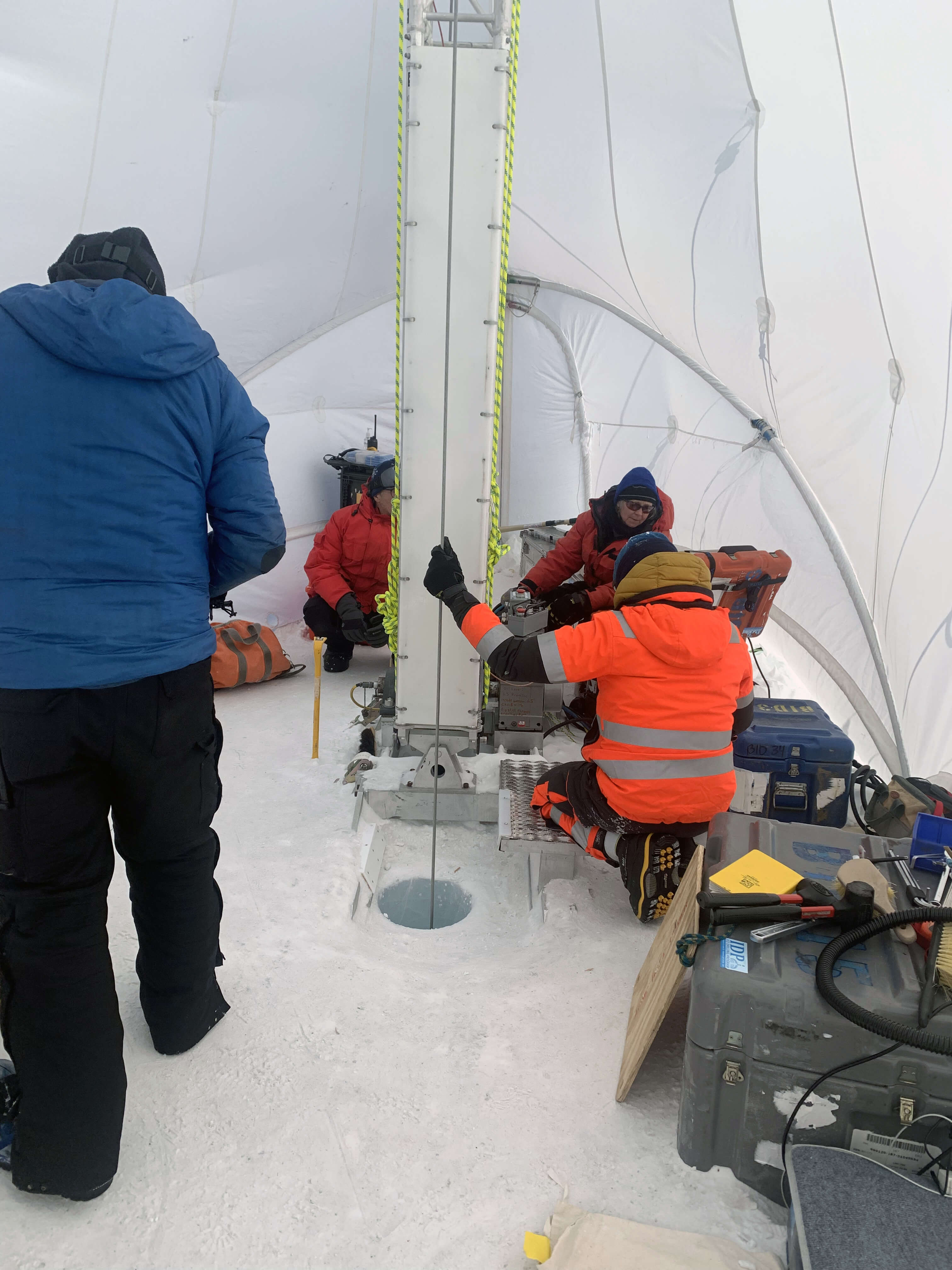
Elizabeth Morton (red jacket and sunglasses) and Andrew Haala (orange jacket) operate the Blue Ice Drill (BID) at Allan Hills, Antarctica. The BID cuts the largest diameter cores (241 mm; 9.5 inches) of all the drills in the NSF Ice Drilling Program drill inventory. Credit: Jenna Epifanio/NSF COLDEX
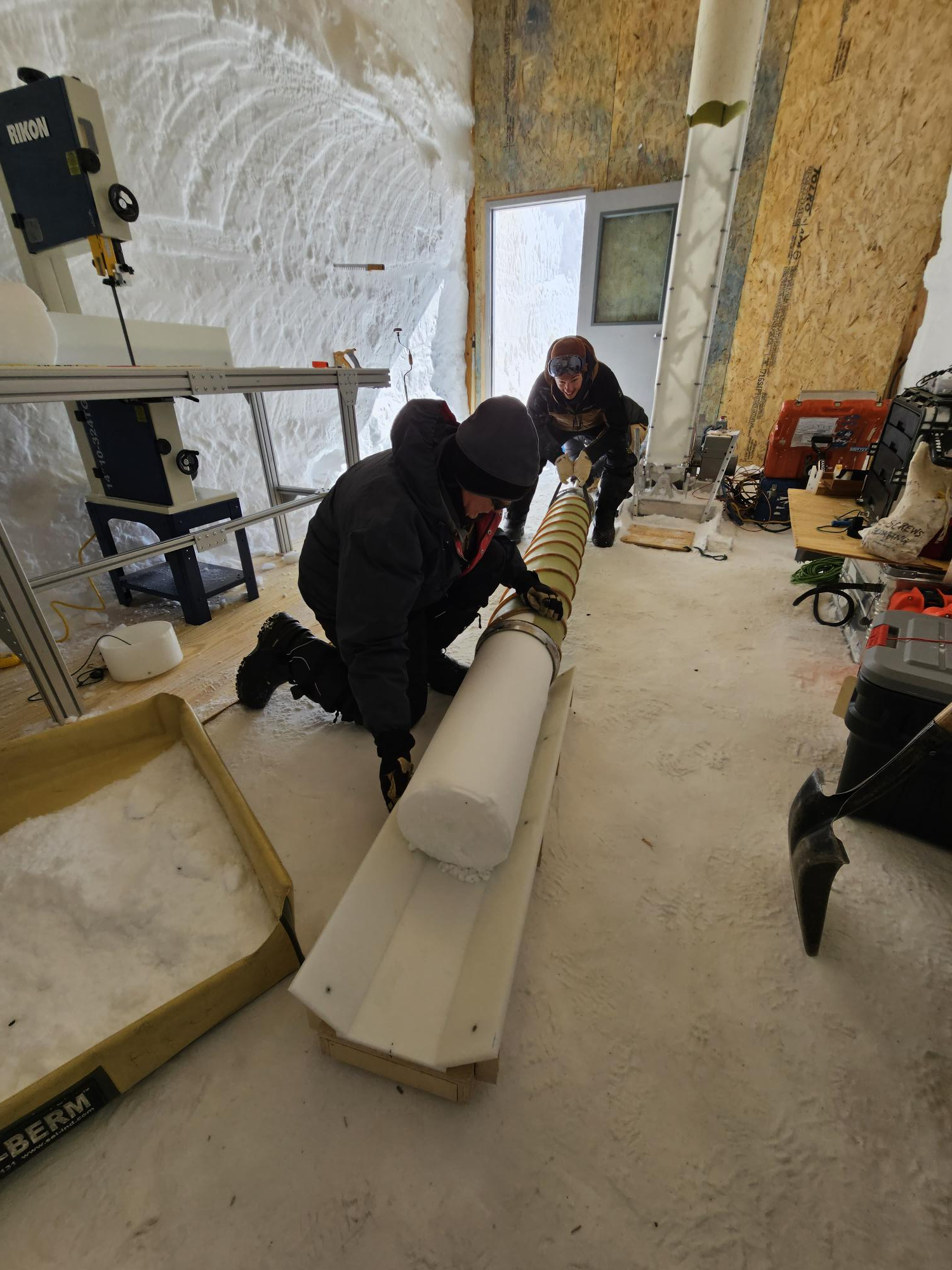
PI Nathan Chellman’s science team pushes a core out of the barrel of the Blue Ice Drill during the 2023 field season at Summit, Greenland. Credit: Nathan Chellman, DRI.
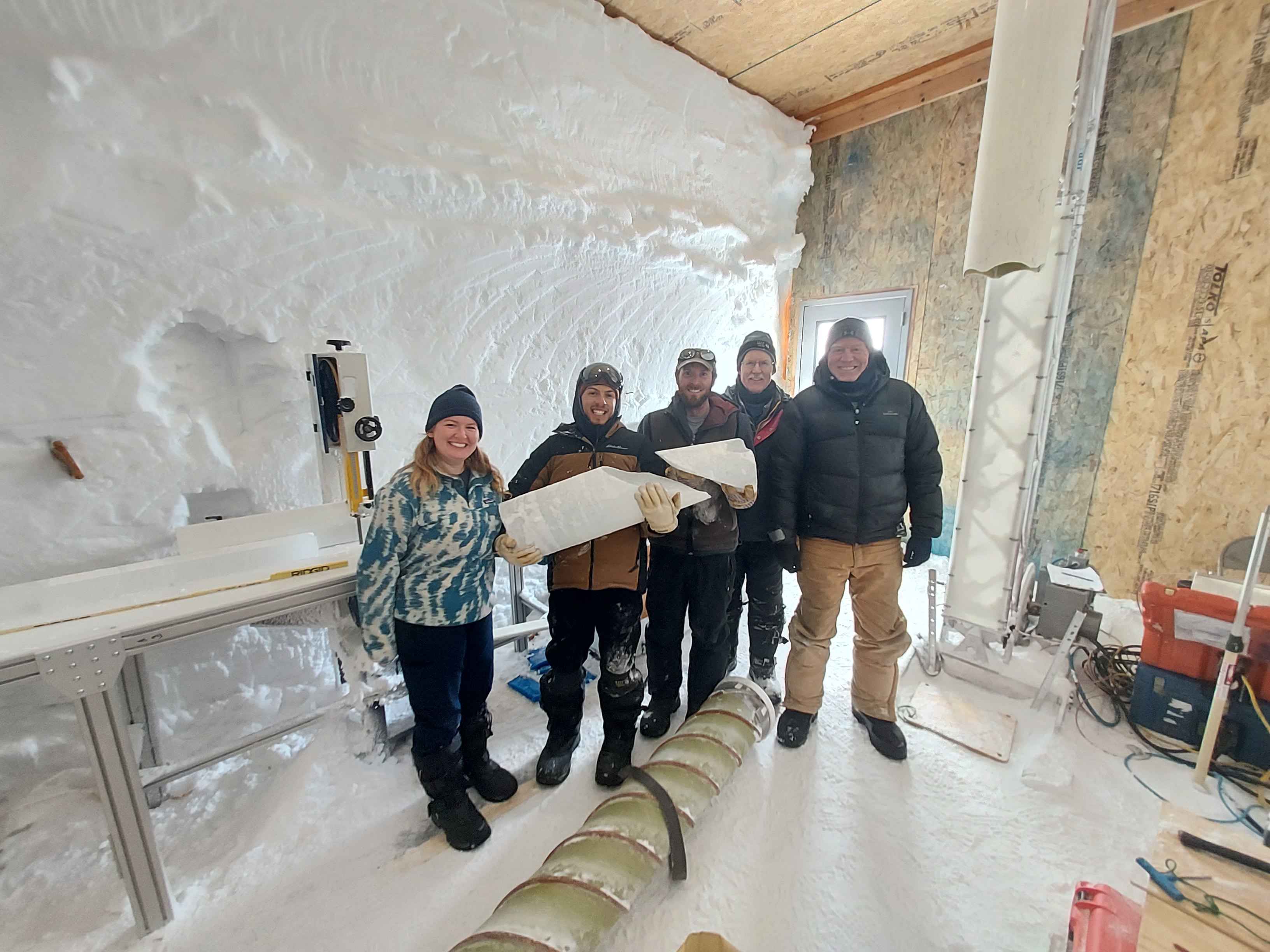
PI Nathan Chellman’s team at Summit Station, Greenland, during the 2023 field season with a large-diameter ice core drilled with the Blue Ice Drill. Credit: Mike Jayred.
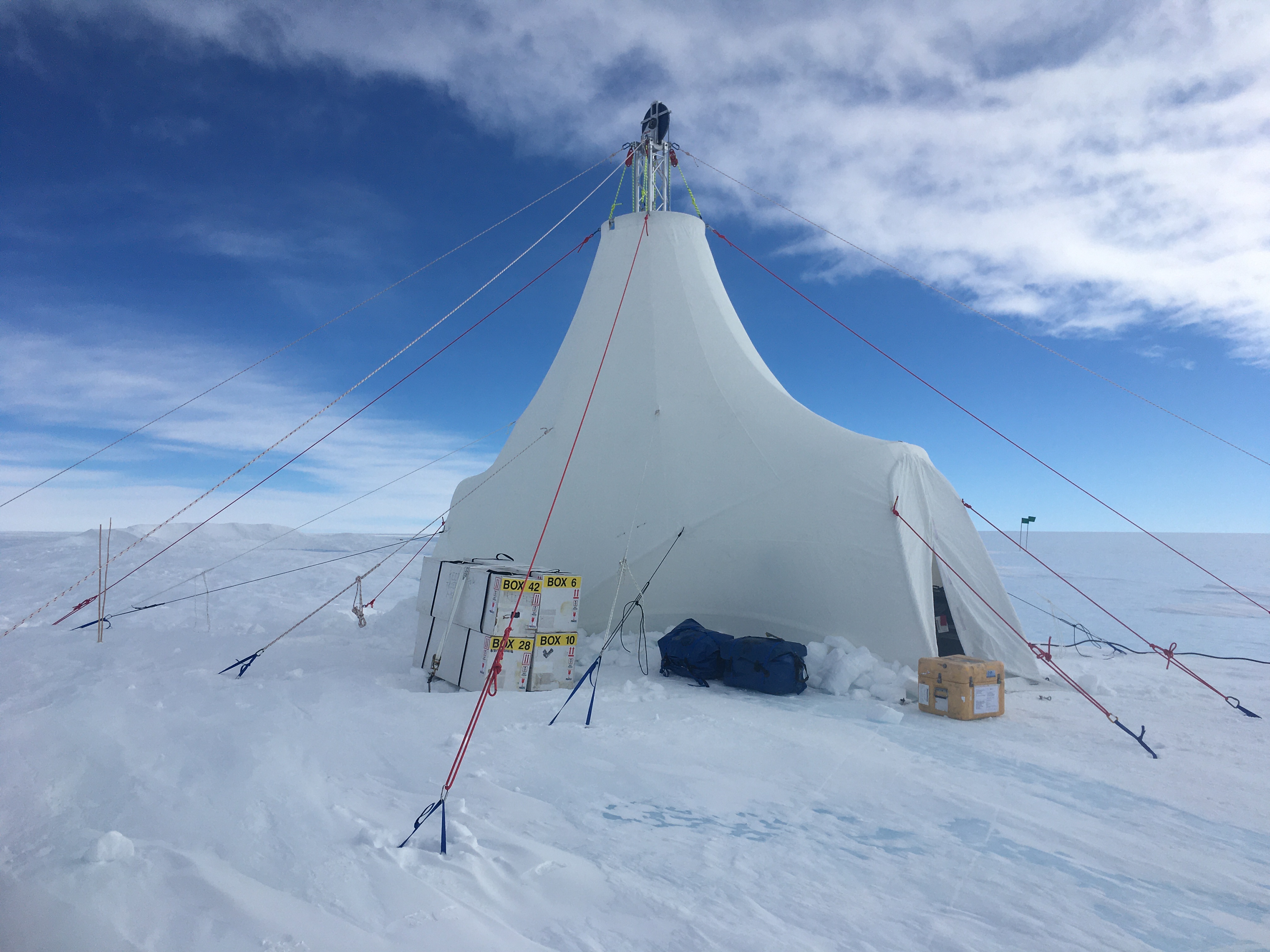
The drill tent for the BID-Deep system at Allan Hills, Antarctica, during the 2019/20 field season. Credit: Tanner Kuhl
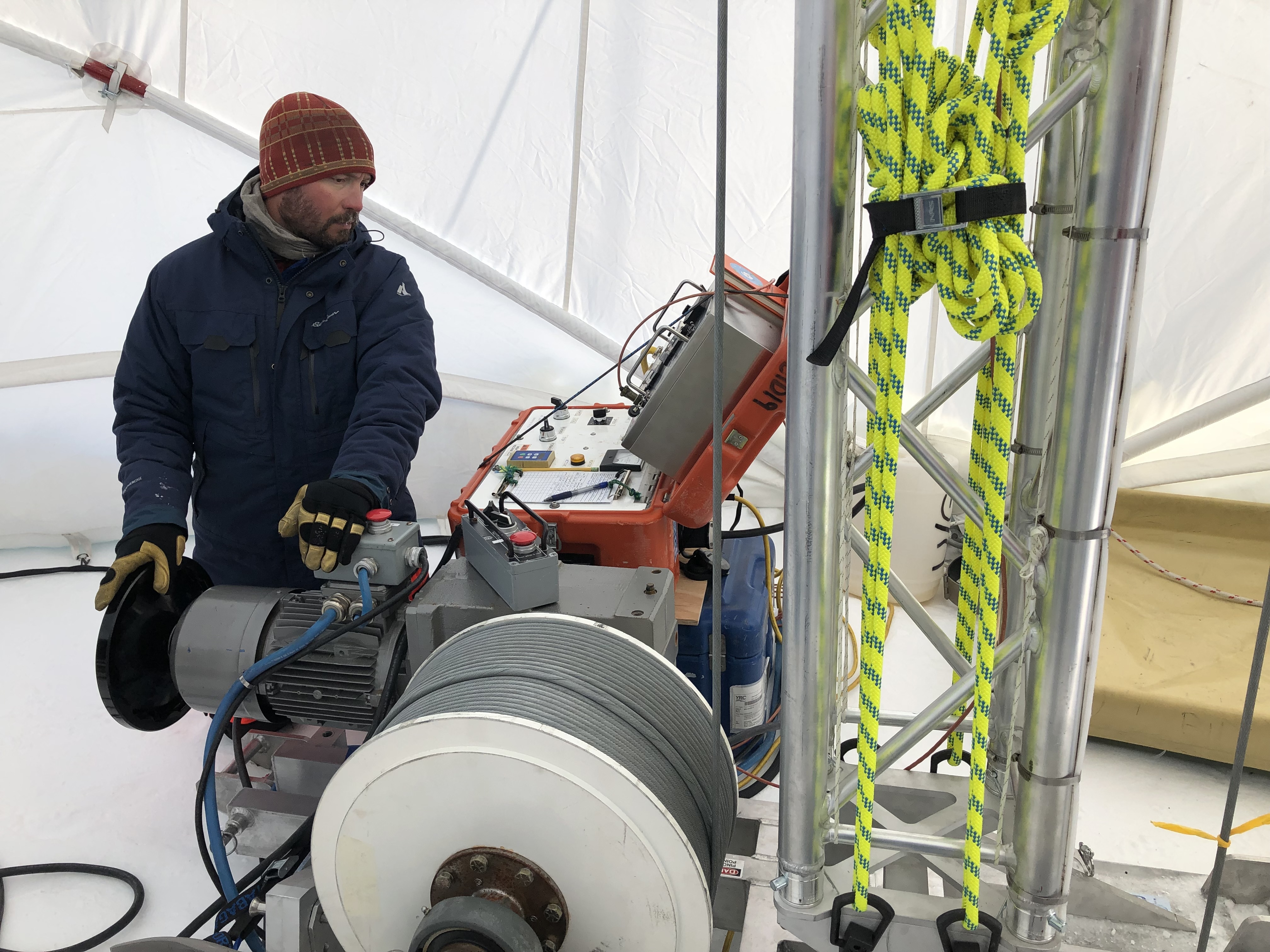
Tanner Kuhl operates the Blue Ice Drill with a new tower at Allan Hills, Antarctica, during the 2019/20 field season. Credit: Jessica Tinker

Interior of the new Blue Ice Drill tent at Law Dome, Antarctica, during the 2018/19 field season. Credit: Peter Neff
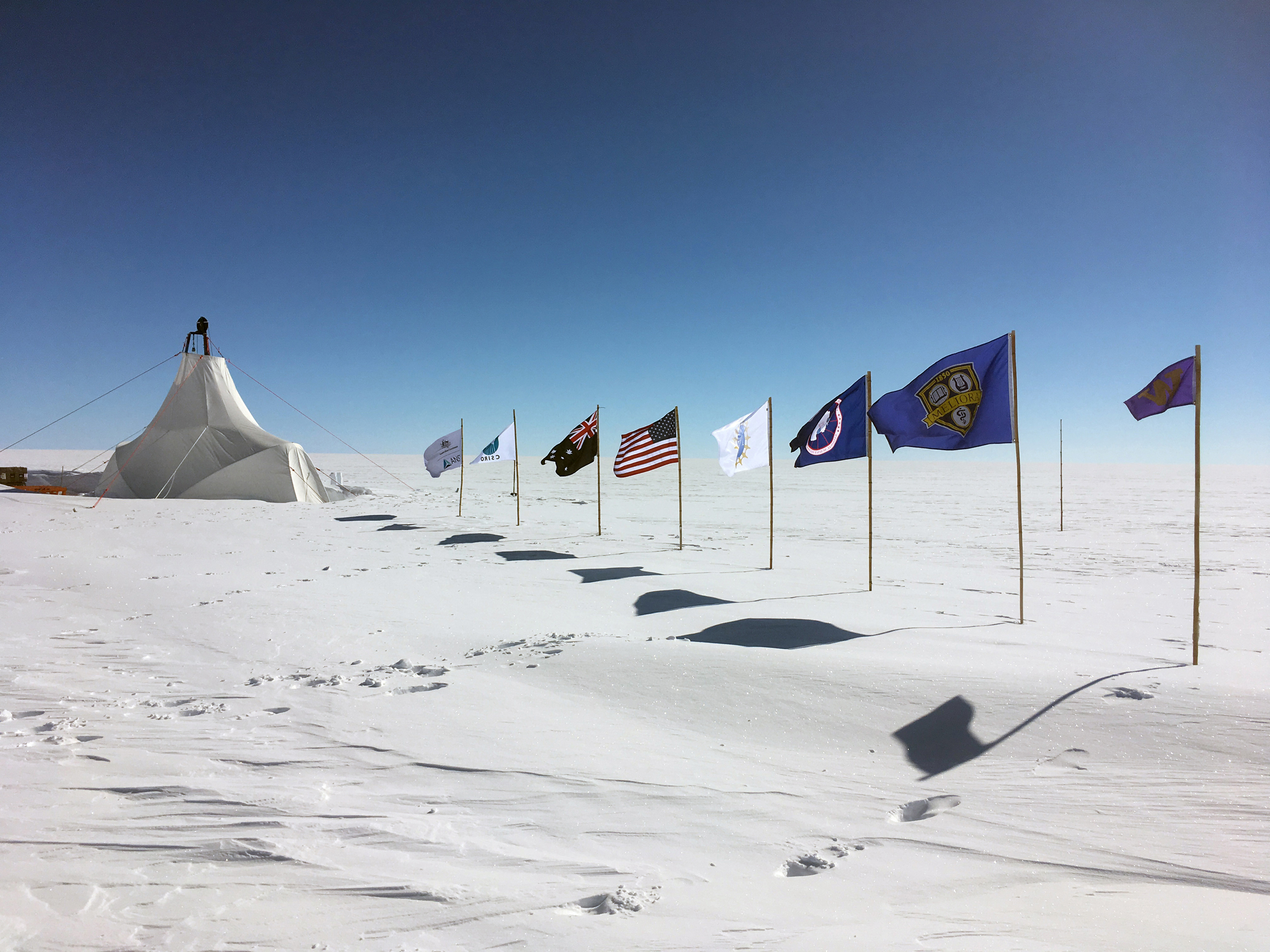
Exterior of the new Blue Ice Drill tent at Law Dome, Antarctica, during the 2018/19 field season. Credit: Tanner Kuhl
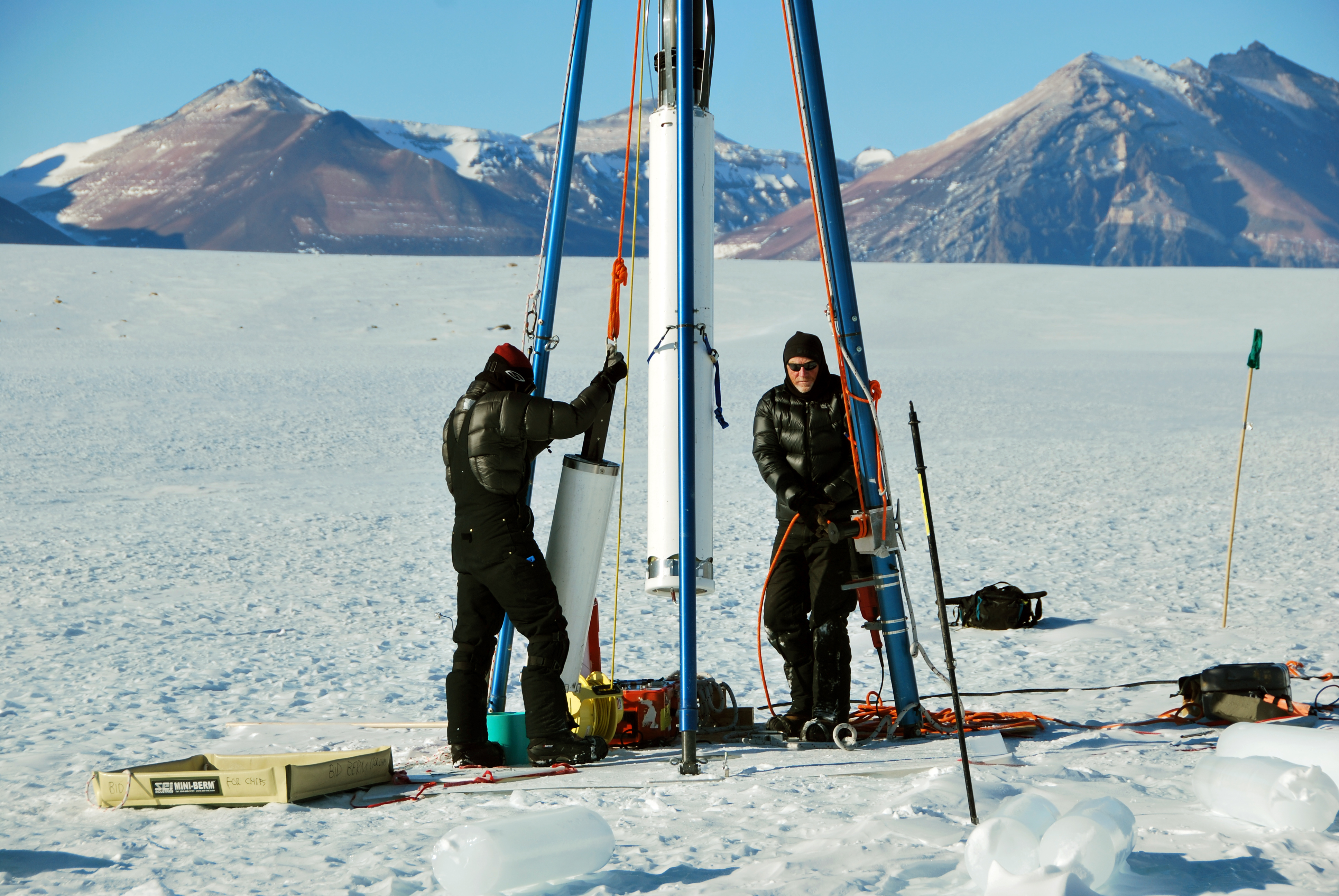
The Blue Ice Drill at Taylor Glacier, Antarctica, during the 2014/15 field season.
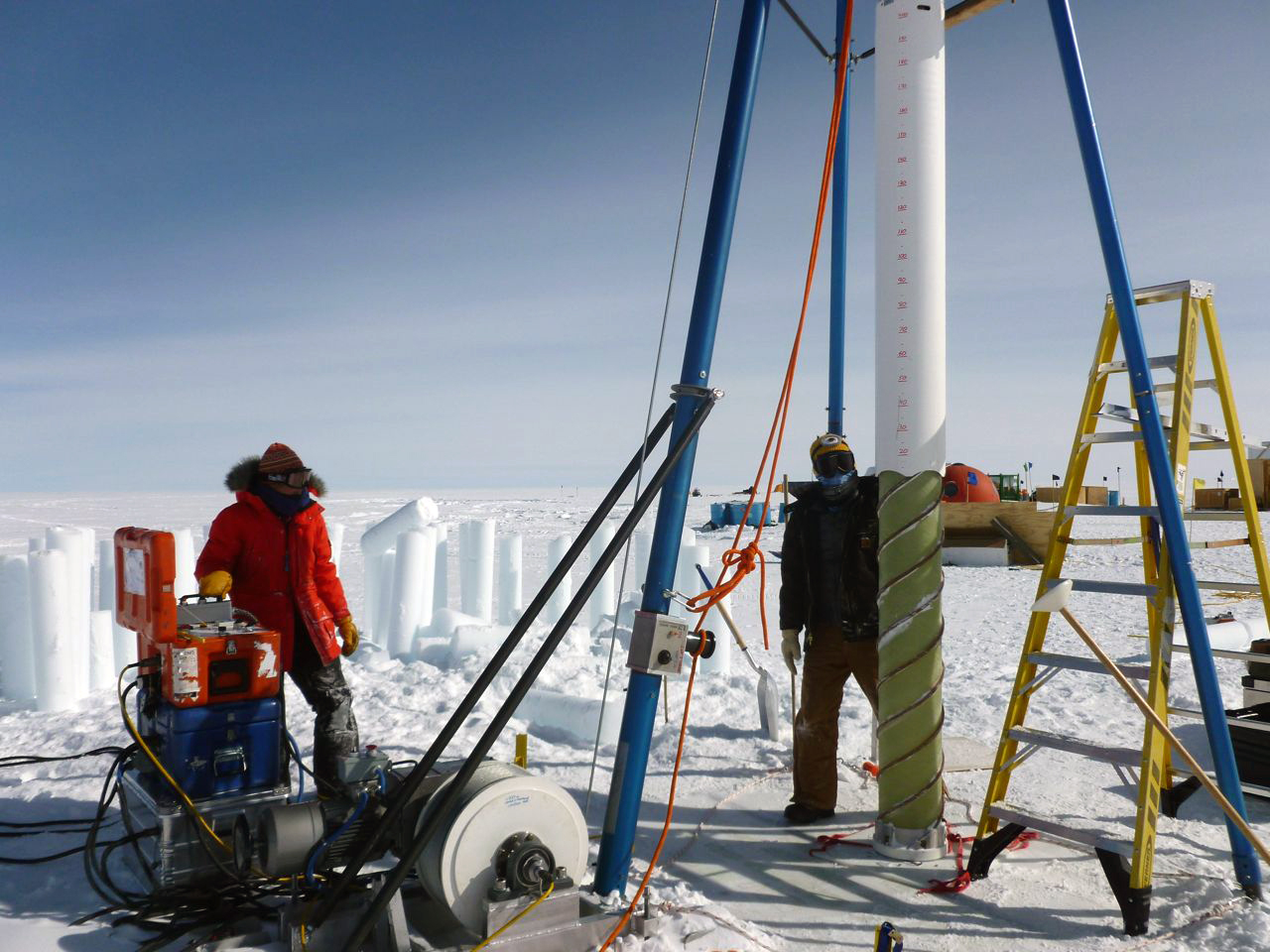
The Blue Ice Drill at Summit, Greenland, during the 2010 field season. Credit: Ben Hmiel

IDP driller Mike Jayred measures an ice core atop of Taylor Glacier during the 2013/14 Antarctic field season. Credit: Peter Rejcek
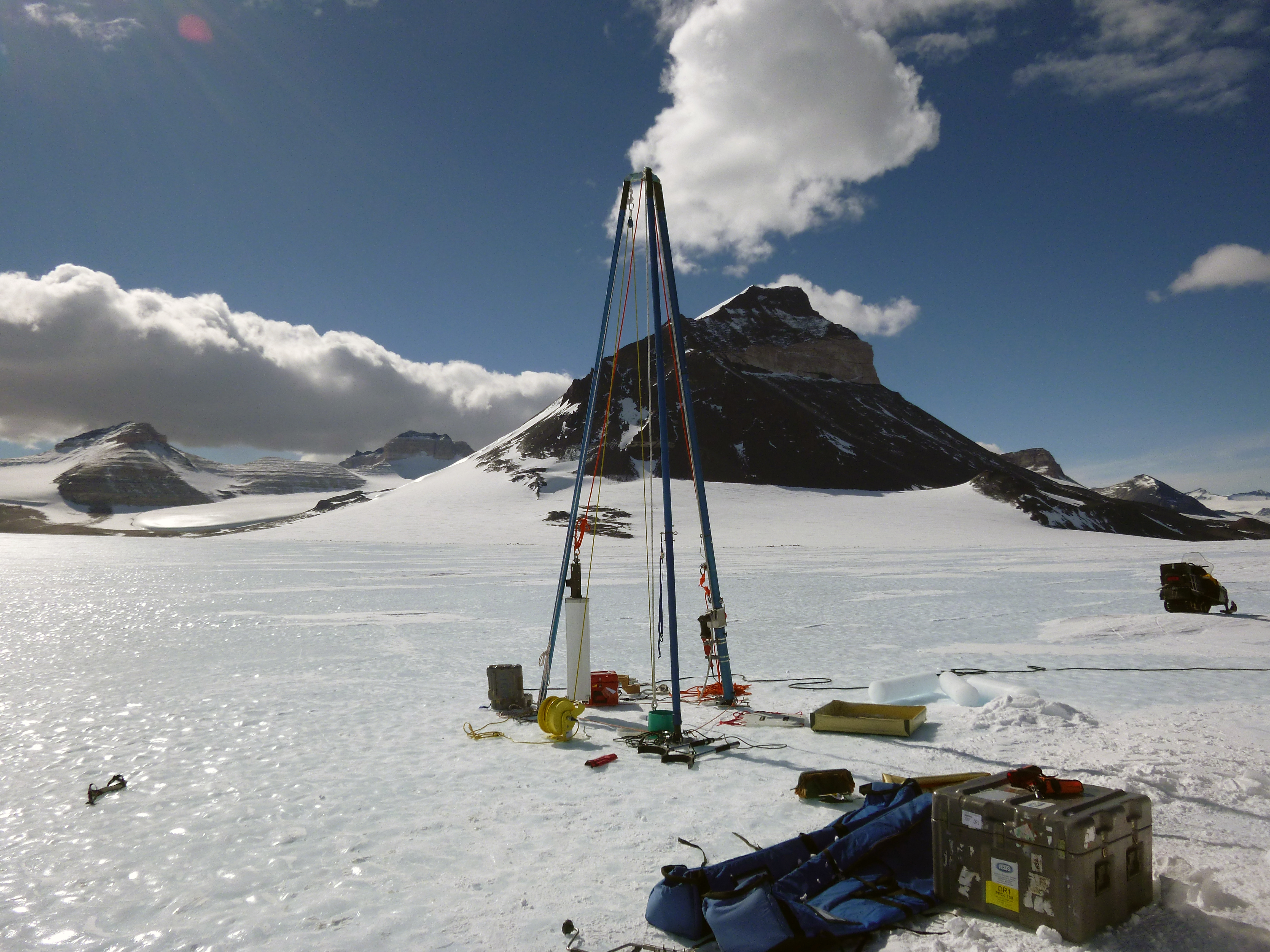
The Blue Ice Drill at Taylor Glacier, Antarctica, during the 2013/14 field season. Credit: Josh Jetson